The veterinarian recommends care and provides an itemized invoice; medical decisions remain between owner and veterinarian.

Independent policy review
Health Insurance for Your Pets: Follow One Bill From Care to Payment
Walk through a hypothetical veterinary visit, separate covered expenses from the full invoice and see who pays before and after a claim.
Policy-first
Independent
Useful checks
Key checks
What matters on this page
Use these checkpoints to frame the literal question before reading the full guide.
Event first
Establish whether the visit is eligible
Coverage check
Invoice second
Separate each expense category
Claim preparation
Payment last
Apply the selected policy formula
Budget check
Direct answer
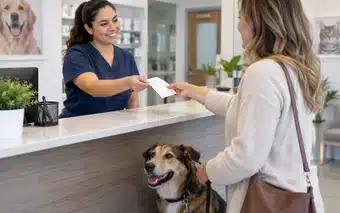
Imagine your pet needs an unexpected veterinary visit after its policy is already in force. Pet health insurance may reimburse eligible expenses, but buying a policy does not make the whole invoice payable. Check the event, timing and exclusions first; only then apply the deductible, reimbursement formula and remaining limit. Plan for the clinic’s payment requirements even when you expect reimbursement.
The sections below show how to verify the answer and what can change it.
A bounded owner scenario
Use one expressly bounded specimen for this invented walkthrough: the Alabama Pets Best / Independence American accident-and-illness form IAIC-PB10001-ILL, rechecked October 7, 2026. Assume a named adult pet, qualifying treatment after all applicable timing gates, no prior related signs, selected 80% reimbursement and $250 deductible remaining. No personal declarations were obtained, so selected amounts and case facts are teaching assumptions, not an issued offer or claim approval.

Process
What happens between appointment and reimbursement
The owner checks the practice’s payment arrangements. Insurance reimbursement and immediate clinic payment are different issues.
The owner submits the required invoice, proof of payment and any requested records within the policy deadline.
The insurer evaluates the claim against history, dates, definitions and exclusions, then identifies eligible expenses.
The insurer applies the contract’s calculation and issues a payment decision; the owner reconciles it against the bill.
Evidence matrix
Apply the Alabama specimen before calculating
| Scenario decision | Actual clause / PDF page | Application to this invented case |
|---|---|---|
| Named pet and eligible event | 1.A / p3 | Assume this pet is named and the event qualifies; otherwise stop |
| History and timing | 5.A.1 / p5; 5.A.4–5 / p6; 5.B.3 / p7 | Assume no prior related signs and care after applicable gates while policy is in force |
| Excluded invoice item | 5.A / pp5–7; 8.B / p10 | Treat $150 as excluded; it never enters the eligible base |
| Supporting records and submission | 7.B,D / pp9–10 | Submit paid itemization and requested history; the sample specifies 180 days |
| Selected amounts and payment | 2.C / p4; 8.A,B,H / pp10–11 | Use declared selections; 80% then $250 produces $1,070 |
| Attached amendment | IAIC-PB10001-PO-AE / p17 | Referral-promotion amendment adds11.D; does not alter these calculation clauses |
Named pet and eligible event
Actual clause / PDF page
1.A / p3
Application to this invented case
Assume this pet is named and the event qualifies; otherwise stop
History and timing
Actual clause / PDF page
5.A.1 / p5; 5.A.4–5 / p6; 5.B.3 / p7
Application to this invented case
Assume no prior related signs and care after applicable gates while policy is in force
Excluded invoice item
Actual clause / PDF page
5.A / pp5–7; 8.B / p10
Application to this invented case
Treat $150 as excluded; it never enters the eligible base
Supporting records and submission
Actual clause / PDF page
7.B,D / pp9–10
Application to this invented case
Submit paid itemization and requested history; the sample specifies 180 days
Selected amounts and payment
Actual clause / PDF page
2.C / p4; 8.A,B,H / pp10–11
Application to this invented case
Use declared selections; 80% then $250 produces $1,070
Attached amendment
Actual clause / PDF page
IAIC-PB10001-PO-AE / p17
Application to this invented case
Referral-promotion amendment adds11.D; does not alter these calculation clauses
Why the full invoice is not the reimbursement base
Evidence matrix
Hypothetical mixed invoice with an annual policy
| Item | Illustrative amount | Treatment in this example |
|---|---|---|
| Total invoice | $1,800 | Amount billed by the clinic |
| Assumed excluded item | $150 | Not included in eligible expense |
| Eligible expense | $1,650 | Assumed covered after policy review |
| 80% reimbursement share | $1,320 | Applied before deductible in this example |
| Remaining deductible | $250 | Subtracted from the calculated share |
| Payment | $1,070 | Before any additional limit would intervene |
| Owner’s final invoice cost | $730 | Invoice minus payment; premium is additional |
Total invoice
Illustrative amount
$1,800
Treatment in this example
Amount billed by the clinic
Assumed excluded item
Illustrative amount
$150
Treatment in this example
Not included in eligible expense
Eligible expense
Illustrative amount
$1,650
Treatment in this example
Assumed covered after policy review
80% reimbursement share
Illustrative amount
$1,320
Treatment in this example
Applied before deductible in this example
Remaining deductible
Illustrative amount
$250
Treatment in this example
Subtracted from the calculated share
Payment
Illustrative amount
$1,070
Treatment in this example
Before any additional limit would intervene
Owner’s final invoice cost
Illustrative amount
$730
Treatment in this example
Invoice minus payment; premium is additional
The $1,070 result now follows section 8.H’s percentage-before-deductible order in the examined Alabama specimen, with our own invented invoice and selected amounts. Section 8.B leaves excluded charges with the owner. If a different contract used a deductible-first calculation, the same teaching inputs would yield $1,120; that alternative is not the examined specimen’s formula. Check any issued amendments and selected schedule before applying either calculation to a real claim.
Compare with the details in front of you
Find Coverage for Your Pet
Ready to check current rates?
Keep policy terms, deductible, reimbursement and limits beside the quote so the comparison stays consistent.
Keep the pet, event and payment questions separate
Practical checks
Three decisions that should not collapse into one
The pet can be enrolled
Enrollment establishes a contract for an identified animal. It does not prove every past or future condition qualifies for payment.
This event can qualify
Date of symptoms, waiting periods, covered causes and excluded services decide whether the event belongs inside the coverage. A new invoice is not necessarily a new condition.
This amount is payable
Even an eligible event can leave the owner with a deductible, percentage contribution, excluded line item or amount above a limit.
For a household with more than one animal, keep each pet’s records and selected benefits distinct. Do not assume one animal’s satisfied deductible or unused allowance transfers to another. If a provider advertises a household discount, obtain the actual terms; a discount is not evidence that claims are pooled. This walkthrough is about following an individual pet’s bill, not selecting a multi-pet product.
Routine care needs its own decision
An annual checkup and treatment for an unexpected problem may have different benefits. Read the wellness or preventive-care schedule separately if offered. A benefit described as health insurance should not be assumed to reimburse every ordinary cost of keeping an animal.
Checklist
Reconcile the claim decision line by line
Match the pet and service dates to the correct policy
Compare excluded amounts with the stated clause and itemized invoice
Confirm the deductible remaining before this claim
Check the reimbursement order, percentage and available limit
Ask for a written explanation if the payment differs from the calculation you can reproduce
If something appears wrong, collect the explanation of benefits, policy wording and supporting records before requesting a review through the insurer’s stated process. Do not alter the clinical record or omit earlier symptoms to make a claim fit. The useful endpoint is an understandable decision and a realistic remaining budget, rather than an assumption that possession of an insurance card settles the bill.
The scope of this specimen check
This is the Alabama sample downloaded from the official state-policy resource on October 7, 2026, including its attached page-17 amendment. Its form identifier is recorded, but the PDF does not give an issue date for a personal contract. The hypothetical pet and selected amounts are not real declarations. Different states, underwriters, policy versions or later amendments require a fresh reading.
FAQ
Common questions
Will the veterinarian send the claim for me?
Ask the practice and insurer. Do not assume the clinic files or waits for reimbursement; confirm your responsibilities before the visit when practical.
Does the policy cover all pets in my home?
Read the named-pet information and any household terms. One pet’s insurance record does not by itself establish coverage for another.
Sources & editorial standards
Independent references
These links provide independent government, academic or reference background. Actual policy wording controls insurance eligibility, benefits and claims.
Keep exploring
Related guides

Pet Insurance Lens
See Insurance Rates
Ready to compare with clearer inputs?
Keep the policy terms beside the price, then continue to rates when the comparison is clear.